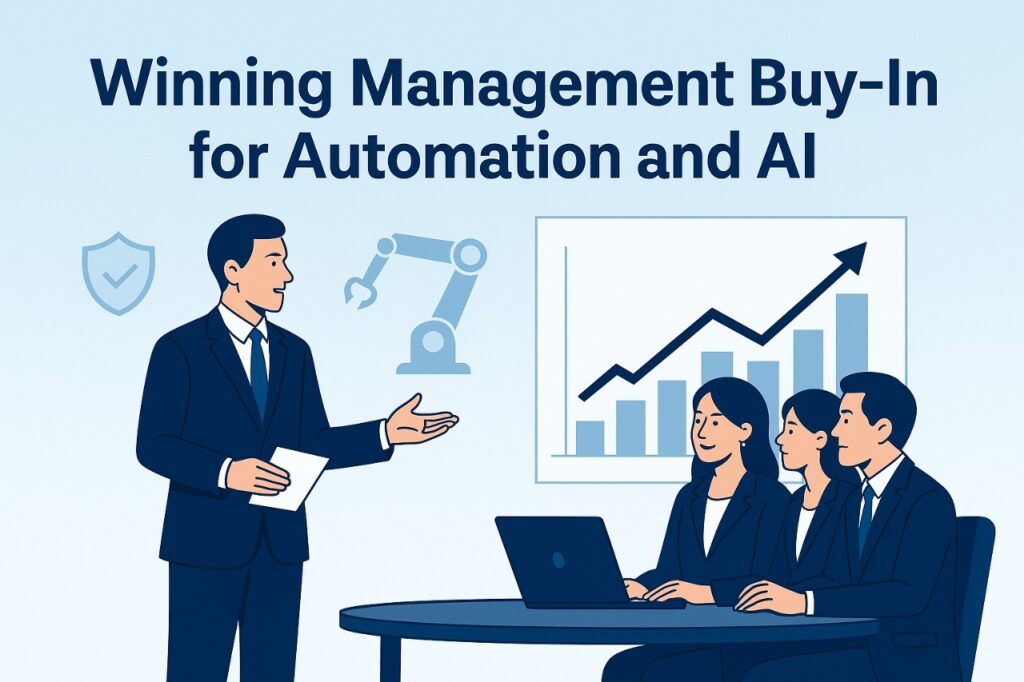
Winning Management Buy-In for Automation and AI
Automation and AI are no longer experimental technologies. They are now boardroom priorities that can reshape cost structures, unlock new growth, and reimagine the way organizations create value. Yet, many initiatives stall because they lack one critical ingredient: management buy-in.
Securing executive sponsorship requires more than technical arguments. It demands a business-first narrative, underpinned by data, proof points, and a clear link to enterprise value.
1. Anchor in Business Outcomes
Executives are less interested in how algorithms work than in how they move the needle on performance. Link automation and AI directly to metrics that matter:
- Revenue growth (e.g., AI-driven personalization that boosts cross-sell by 10–15%).
- Cost efficiency (e.g., RPA reducing manual reconciliation costs by 30–60%).
- Risk management (e.g., AI fraud analytics that cut false positives by 50%).
Framing technology as a lever for P&L impact changes the conversation.
2. Start with Quick Wins, Then Scale
Executives back what they can see. Begin with targeted pilots that deliver fast, tangible results—such as automating KYC checks or streamlining invoice processing. Demonstrate ROI within 3–6 months, then use these results as a platform to scale.
McKinsey research shows that organizations capturing early wins are 2.5x more likely to scale automation successfully across the enterprise.
3. Quantify and Communicate ROI
Management alignment depends on hard numbers. Translate technical gains into business language:
- “This automation saves 100,000 hours annually = 50 FTEs = $3 million cost reduction.”
- “AI-enabled onboarding improves customer satisfaction scores by 25%.”
Concrete ROI builds credibility and accelerates decision-making. Deloitte, for example, finds that RPA ROI ranges between 30%–200% in the first year
4. Reframe the Workforce Debate
One of the biggest barriers to buy-in is fear of workforce disruption. Shift the narrative:
- Augmentation, not elimination: automation frees capacity for higher-value work.
- Capability building: create pathways to upskill staff into digital and analytical roles.
McKinsey estimates that while 60% of jobs have at least 30% of tasks that can be automated, very few roles are fully automatable. The message is evolution, not elimination.
5. Engage Leadership Early and Often
Buy-in is strongest when executives shape the journey. Bring leaders into the design process, co-create KPIs, and tie automation outcomes directly to strategic priorities.
Peer pressure also works: benchmark against competitors and highlight risks of being left behind. In fast-moving sectors like banking, inaction can be more expensive than investment.
6. Position Automation as a Risk Shield
In highly regulated industries, automation is not just about speed—it is about control.
- Automated audit trails reduce compliance risk.
- AI-driven anomaly detection strengthens fraud prevention.
- Standardized processes mitigate operational errors.
By framing automation as a risk and resilience strategy, you expand its appeal to boards and regulators.
7. Tell the Transformation Story
Data convinces; stories inspire. Use narrative to connect automation with enterprise vision:
- “Imagine reducing onboarding from 3 days to 30 minutes.”
- “Picture compliance checks running in real time, not weeks later.”
- “Envision employees focused on clients, not spreadsheets.”
Leaders invest in possibilities, not just processes.
The Bottom Line
Winning management buy-in is not about selling a technology—it’s about orchestrating a business case that links automation to growth, resilience, and competitive advantage.
Organizations that position automation as a strategic enabler—not a tactical fix—are the ones that secure executive sponsorship, scale faster, and capture outsized value.
As McKinsey often frames it: technology adoption succeeds when it creates impact at scale and earns the trust of leadership.
References
- McKinsey & Company – The state of AI in 2023: Generative AI’s breakout year
- Deloitte – Automation with intelligence: RPA and cognitive automation survey
- McKinsey Global Institute – A future that works: Automation, employment, and productivity
- PwC – Sizing the prize: The economic impact of AI
- Gartner – Market Guide for RPA 2024