
End-to-End Digital Transformation: Engineering ROI Through Intelligent Automation
A strategic approach to transforming enterprise operations—powered by executive leadership, enabled by process owners, and measured by outcomes.

In an era where digital transformation defines competitive advantage, organizations can no longer afford half-measures or fragmented automation attempts. Yet, data shows that over 70% of automation and AI initiatives fail to scale—not because of technology limitations, but due to the absence of strong leadership intent and lack of process owner engagement.
Quickfox Consulting’s transformation model directly addresses this challenge, anchoring automation not as an IT project, but as a CEO-level mandate with accountability built into every phase of execution.
1. Transformation as Strategic Imperative—Not a Technology Pilots
Enterprise-wide automation must be initiated with clear intent from top management. Without executive sponsorship, projects lose direction, adoption suffers, and departments become resistant to change.
Why Leadership Intent Matters:
- Aligns automation with business and financial objectives
- Removes interdepartmental resistance
- Ensures prioritization, budget, and resources
- Elevates transformation from operational activity to strategic agenda
Without leadership commitment, automation remains a proof-of-concept exercise—delivering fragmented value at best, and outright failure at worst.
2. Discovery Phase – Where Business Value is Engineered
This is the defining moment of the transformation journey. It is not an IT-led initiative, but a joint effort between the CXO office, consulting team, and functional leaders.
Discovery Framework:
| Stakeholder | Role | Impact |
|---|---|---|
| Top Management (Board/CXO) | Provides mandate, vision, timeline, ROI targets | Ensures strategic alignment |
| Process Owners & Department Heads | Validate workflows, share ground realities | Ensures practicality and adoption |
| Consulting Team | Map current vs. automated state, quantify value | Establishes the business case |
When process owners are not involved, automation fails at deployment, as ground-level realities are overlooked, and ownership is missing.
3. Measurement-Driven Transformation
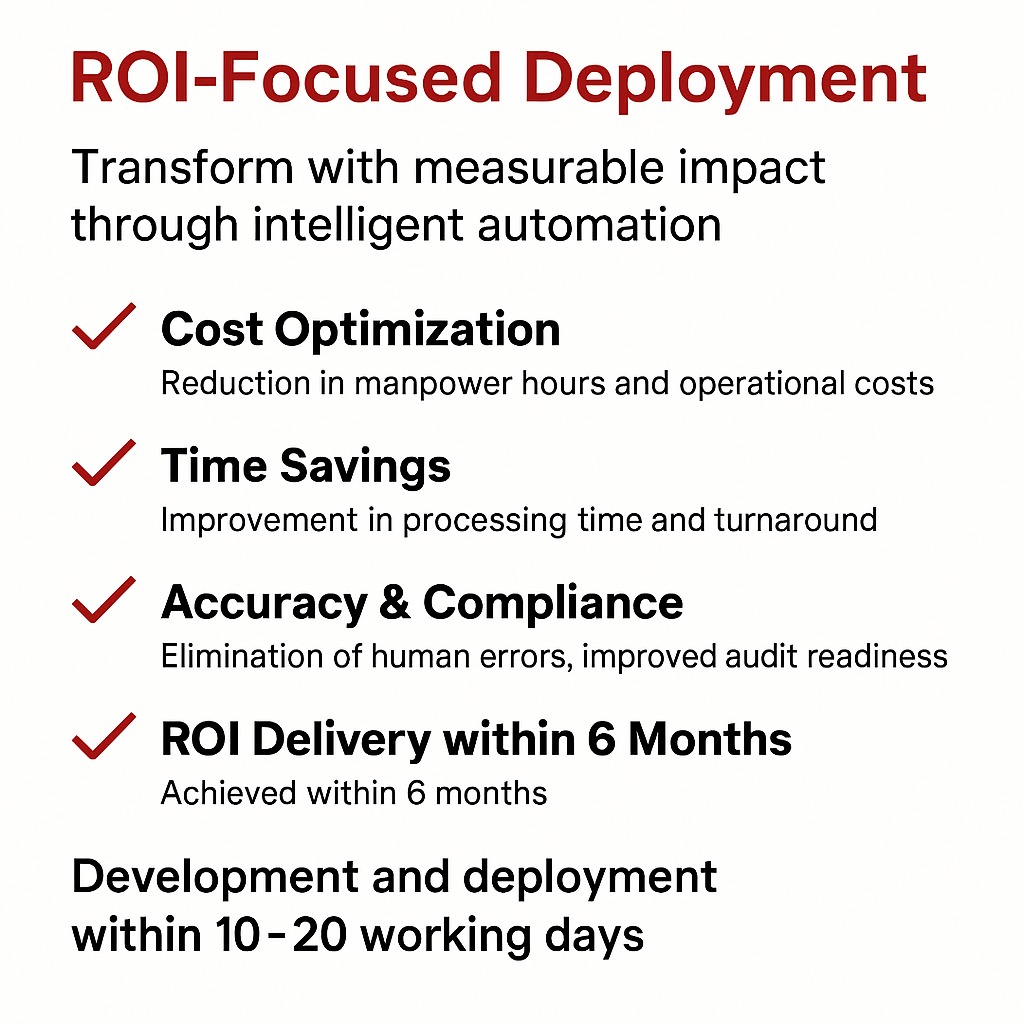
Quickfox’s approach is rooted in accountability. Every automation initiative is evaluated on pre-defined metrics:
- Cost Reduction
- Time Savings
- Error Elimination
- Compliance Improvement
- ROI Delivery within a defined timeframe
We do not automate for convenience—we automate for impact.
4. Implementation that Scales – Powered by Human + Digital Synergy
A successful transformation requires technology deployment AND human adoption.
That is why we embed change management, training, and governance frameworks, ensuring departments do not resist automation—but lead it.
Critical Success Factors:
- Executive sponsorship
- Process owner accountability
- Quantifiable ROI metrics
- Scalable technical architecture
5. Why Transformation Fails Without Leadership and Ownership
Automation will fail—not for technical reasons—but due to organizational resistance, lack of clarity, and absence of top-down commitment.
- If leadership treats automation as an experiment, it remains one.
- If process owners are not accountable, automation becomes an external imposition—not an internal transformation.
- If ROI is not defined, value can never be measured.
In Short:
Automation without leadership intent is vision without traction. Automation without process owner involvement is execution without ownerhsip.
Conclusion: Intelligent Transformation Requires Intelligent Leadership
End-to-end digital transformation succeeds when it is driven as a business transformation, not a technology implementation. With leadership intent and process-owner engagement as the backbone, organizations can unlock scalable automation, accelerate ROI, and future-proof their operations.
Quickfox Consulting empowers enterprises to transform with intelligence, accountability, and measurable impact.