How SMBs Can Adopt AI While Minimizing Risk and Maximizing Returns
Artificial intelligence is advancing rapidly, and its impact is spreading beyond large enterprises. For small and medium businesses (SMBs), the question is no longer whether to adopt AI but how. The prize is significant—faster processes, better customer experiences, and improved compliance. The risks, however, are equally real: unclear ROI, organizational resistance, and wasted investment.
The path forward requires a disciplined approach: align AI with strategy, secure buy-in, select the right tools, and execute with agility.

Anchor AI in Strategic Vision
Successful AI adoption begins with clarity of intent. Leadership must define how AI supports the business model and growth agenda. The questions to answer are straightforward:
- What problem are we solving? (e.g., reducing back-office effort, improving compliance reporting)
- Where do we start? (prioritize high-value, low-complexity use cases)
- What is the horizon? (balance quick wins with a scalable roadmap)
Without a strategic north star, AI risks becoming a technology experiment. With one, it becomes a driver of performance.
Build Stakeholder Confidence
Technology alone does not deliver outcomes—people do. For SMBs, close-knit teams and limited resources make buy-in critical.
- Employees need to see AI as an enabler, not a threat. Upskilling and communication reduce resistance.
- Customers must feel improvements in speed, accuracy, and personalization.
- Partners and regulators require assurance that compliance, ethics, and security are safeguarded.
Early proof points build trust. Visible wins create momentum.
Choose Tools with Precision
SMBs cannot afford sprawling AI programs. The focus should be on “fit-for-purpose” solutions:
- Problem-solution alignment: Does the tool address a defined business need?
- Ease of integration: Can it work within existing infrastructure?
- Affordability and scalability: Is it modular, flexible, and cost-effective?
For many SMBs, starting with targeted solutions—robotic process automation, document digitization, or AI-driven analytics—delivers impact quickly and at manageable risk.
Measure Impact Rigorously
ROI must be clear, not assumed. A structured impact framework helps:
- Time: Hours of manual effort reduced.
- Cost: Net savings after investment.
- Service: Improvements in accuracy, speed, and customer experience.
- Compliance: Stronger reporting and reduced error.
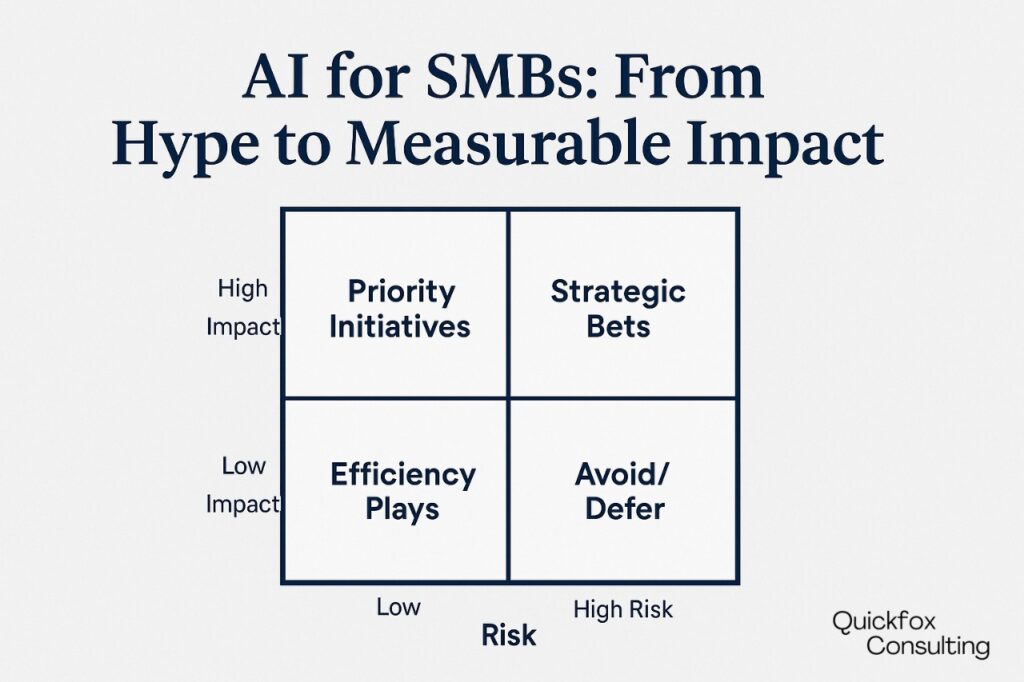
A simple 2×2 impact–risk matrix can help SMBs prioritize use cases:
Execute Through Agile Pilots
Technology evolves continuously. Static, one-off projects are insufficient. An agile build approach—short sprints, iterative pilots, rapid scaling—is essential.
- Pilot: Test in controlled areas.
- Validate: Measure against baseline metrics.
- Scale selectively: Expand only where ROI is proven.
- Iterate: Adjust as customer needs, regulations, and tools evolve.
Agility minimizes sunk costs, accelerates learning, and ensures relevance.
Embed Continuous Improvement
AI is not a project—it is a capability. Sustaining returns requires ongoing monitoring and iteration:
- Regular feedback loops from employees and customers.
- Performance tracking to ensure accuracy and reliability.
- Ongoing upgrades to align with evolving technologies and standards.
SMBs that embed improvement into their operating model extend the life and value of their AI investments
The Way Forward
For SMBs, adopting AI is less about timing and more about approach. The risks of moving early can be mitigated; the risks of moving too late are harder to recover from.
A winning formula rests on six imperatives:
- Anchor adoption in strategic vision.
- Build stakeholder confidence.
- Choose precise, affordable tools.
- Measure impact rigorously.
- Execute through agile pilots.
- Embed continuous improvement.
By treating AI as a business discipline—not a technology gamble—SMBs can minimize risk, accelerate returns, and secure competitive advantage in an increasingly digital economy.